1

Tour director platform

Tour director platform: Reducing onboarding session time by 37.5%, resulting in the recovery of 2,475 hours of paid labour annually

Tour director platform: Reducing onboarding session time by 37.5%, resulting in the recovery of 2,475 hours of paid labour annually

Tour director platform: Reducing onboarding session time by 37.5%, resulting in the recovery of 2,475 hours of paid labour annually

Tour Directors (TDs) are essential to EF’s Educational Tours, delivering seamless travel experiences.


However, their pre-tour preparation was highly inefficient due to a fragmented knowledge base and unstructured resources. This forced an over-reliance on lengthy, expensive staff-led onboarding sessions, driving up variable labor costs, resulting in significant six-figure annual expenses for the business.

Tour Directors (TDs) are essential to EF’s Educational Tours, delivering seamless travel experiences.


However, their pre-tour preparation was highly inefficient due to a fragmented knowledge base and unstructured resources. This forced an over-reliance on lengthy, expensive staff-led onboarding sessions, driving up variable labor costs, resulting in significant six-figure annual expenses for the business.

Role | UX/Service Designer

Role | UX/Service Designer

Team | Design

Team | Design

Timeline | 2 Months

Timeline | 2 Months

Problem

Costly 4 hour onboarding driven by fragmented resource

Costly 4 hour onboarding driven by fragmented resource

Tour Directors waste excessive time preparing for new itineraries, relying on lengthy, expensive onboarding sessions because of a lack of unified resources.

Tour Directors waste excessive time preparing for new itineraries, relying on lengthy, expensive onboarding sessions because of a lack of unified resources.

Solution

Shifting to self-service with structured content architecture

Shifting to self-service with structured content architecture

A well structured resource platform compiling all necessary information as a mandatory step in Tour Director’s pre-tour tasks.

A well structured resource platform compiling all necessary information as a mandatory step in Tour Director’s pre-tour tasks.

Objectives

Objectives

Objectives

  1. Reduce operational dependency. Design a cohesive, self-service knowledge bank that minimises the reliance of staff-led onboarding sessions.

  1. Reduce operational dependency. Design a cohesive, self-service knowledge bank that minimises the reliance of staff-led onboarding sessions.

  1. Increase preparation efficiency. Cut onboarding sessions and reduce operational costs.

  1. Increase preparation efficiency. Cut onboarding sessions and reduce operational costs.

Discovery

Service blueprinting and heuristic analysis exposed high-effort pain points in the pre-tour preparation and content contribution

Service blueprinting and heuristic analysis exposed high-effort pain points in the pre-tour preparation and content contribution

Facing an urgent need to deploy a solution before the next tour season, I suggested a lean discovery phase, leaning on the expertise of a Learning Specialist (a 10+ year veteran TD) as a proxy user for rapid systemic diagnosis, a necessary trade-off for speed and agility.


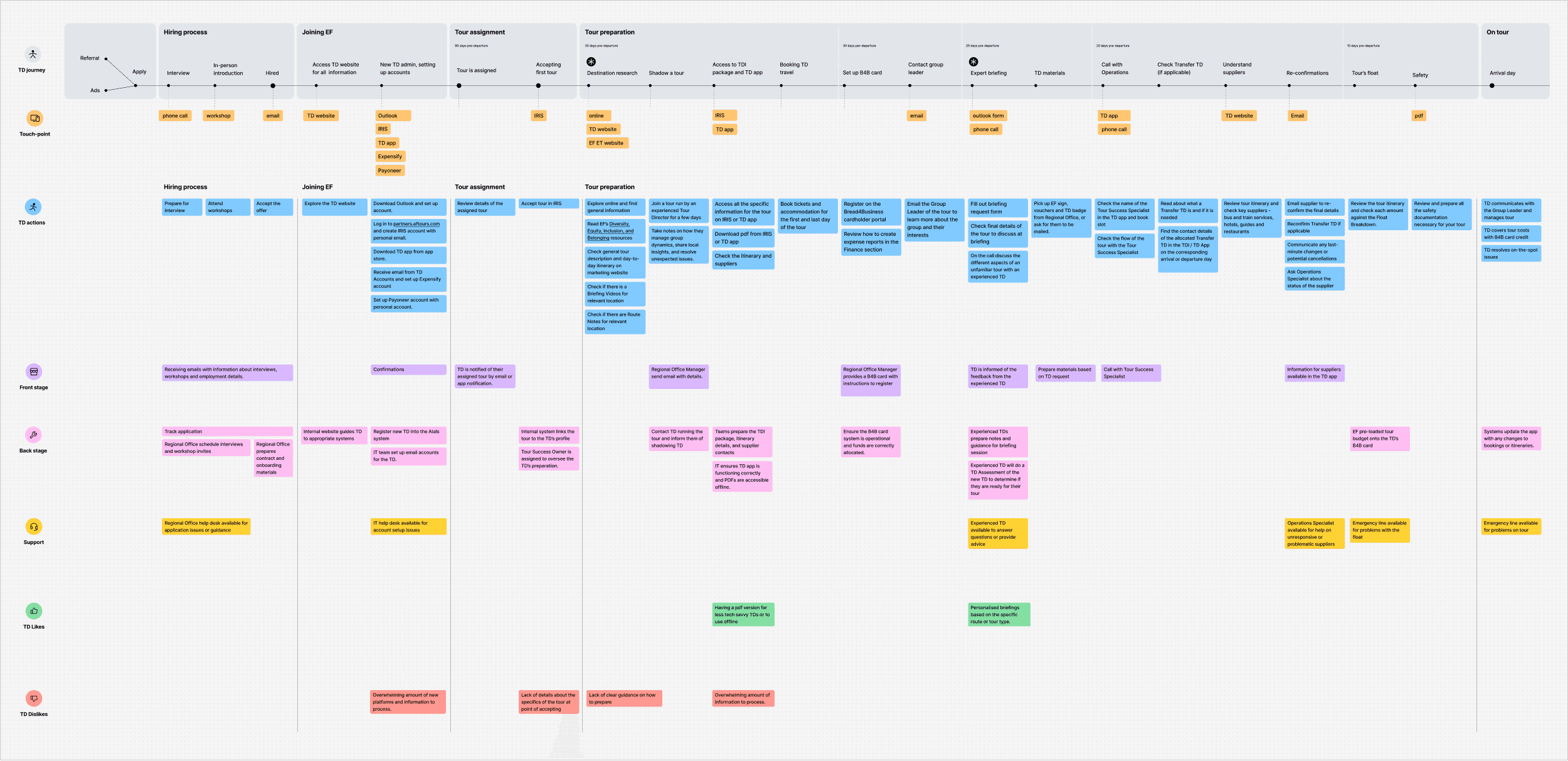
Mapping the pre-tour user journey in a service blueprint helped us verify that the preparation phase represented the highest effort and cost for the Tour Director (TD) and the business respectively.

Facing an urgent need to deploy a solution before the next tour season, I suggested a lean discovery phase, leaning on the expertise of a Learning Specialist (a 10+ year veteran TD) as a proxy user for rapid systemic diagnosis, a necessary trade-off for speed and agility.


Mapping the pre-tour user journey in a service blueprint helped us verify that the preparation phase represented the highest effort and cost for the Tour Director (TD) and the business respectively.

An analysis of the existing digital resources revealed major usability gaps that contributed directly to inefficiency.


Heuristic failure. The old site scored poorly on Aesthetic and Minimalist Design and Consistency and Standards. Content was hidden behind complex navigations and excessive collapsible sections.


Content gap. The platform lacked the granular, actionable planning content TDs needed (e.g., local transport rules, precise timing estimates, critical contact lists). This forced TDs to waste excessive unpaid time researching external sites.

An analysis of the existing digital resources revealed major usability gaps that contributed directly to inefficiency.


Heuristic failure. The old site scored poorly on Aesthetic and Minimalist Design and Consistency and Standards. Content was hidden behind complex navigations and excessive collapsible sections.


Content gap. The platform lacked the granular, actionable planning content TDs needed (e.g., local transport rules, precise timing estimates, critical contact lists). This forced TDs to waste excessive unpaid time researching external sites.

Key findings

Key findings

Key findings

  1. Long onboarding sessions. The pre-tour preparation sessions for new itinerary items are information dumps that cost the business.

  1. Long onboarding sessions. The pre-tour preparation sessions for new itinerary items are information dumps that cost the business.

  1. Dispersed content. Driving pre-tour dissatisfaction and forcing them to spend excessive unpaid time researching details.

  1. Dispersed content. Driving pre-tour dissatisfaction and forcing them to spend excessive unpaid time researching details.

  1. Knowledge decay and silos. Difficult to capture and maintain local knowledge from a decentralised freelance workforce.

  1. Knowledge decay and silos. Difficult to capture and maintain local knowledge from a decentralised freelance workforce.

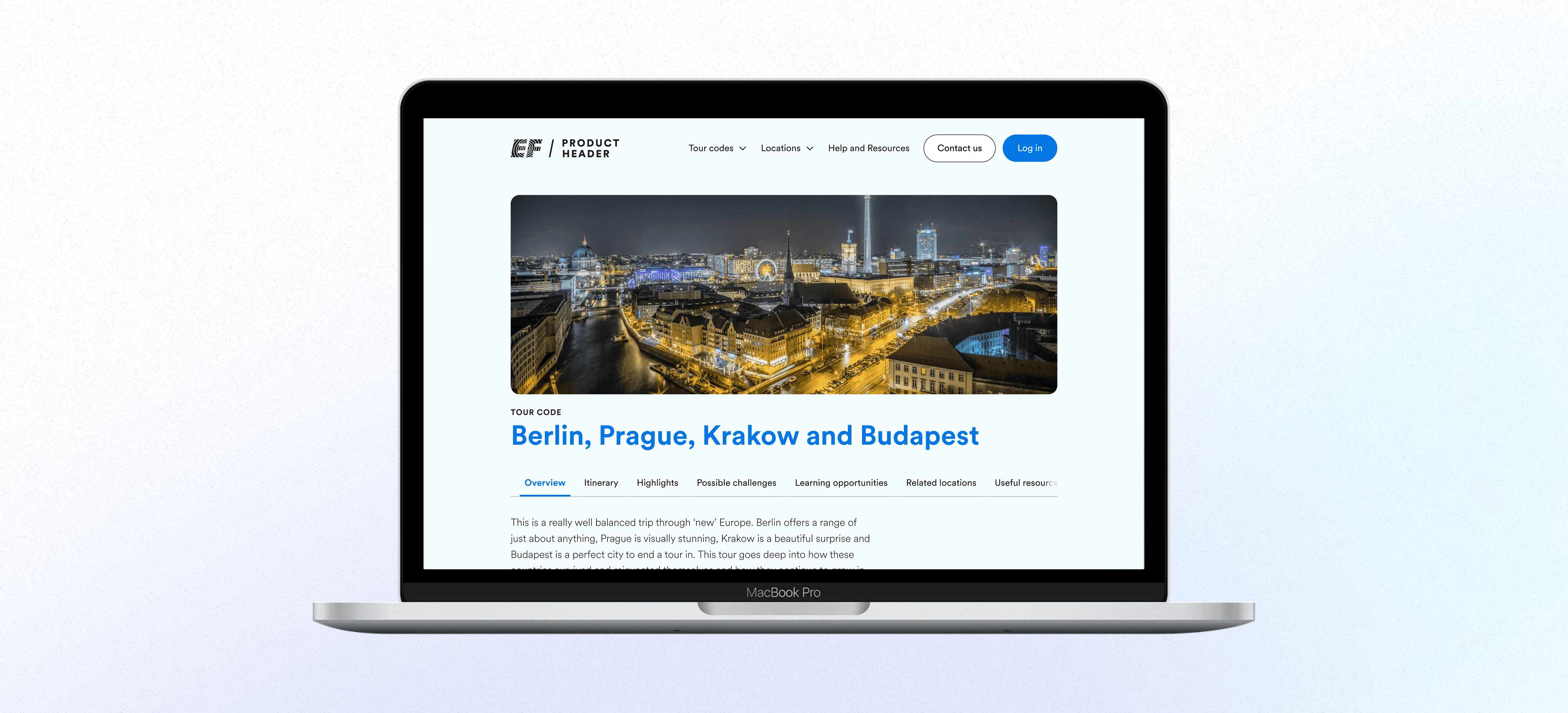
Fig.1 With a limited amount of time, I crafted a simple to build main template for the tour itinerary and a second template that would fit the city, experience and transport content.

Design

Solving the knowledge fragmentation through a dual focus approach tackling self-service and content maintenance

Solving the knowledge fragmentation through a dual focus approach tackling self-service and content maintenance

I tackled the core challenge of fragmented knowledge driving operational cost with a dual-focused design strategy to ensure immediate impact and long-term sustainability.

I tackled the core challenge of fragmented knowledge driving operational cost with a dual-focused design strategy to ensure immediate impact and long-term sustainability.

Interventions

Interventions

Interventions

  1. Resource optimisation to enable self service and reduce onboarding duration

  1. Resource optimisation to enable self service and reduce onboarding duration

  1. Knowledge capturing and maintaining with low-friction contribution to ensure system longevity

  1. Knowledge capturing and maintaining with low-friction contribution to ensure system longevity

Resource optimisation and session reduction. The goal was to transform the costly 4-hour staff-led information dump into a self-service learning model.


Modular & consistent design. I created simple, modular templates for the four key content types (Itinerary, City, Activity, Transport). This consistency drastically reduced the TD's cognitive load, speeding up information intake by eliminating the need to re-learn a new layout for every resource.


F-pattern hierarchy. I prioritised critical planning and logistics information at the top of the page. This focused visual hierarchy enabled TDs to rapidly scan and triage information, making self-service feasible and reducing frustration.

Resource optimisation and session reduction. The goal was to transform the costly 4-hour staff-led information dump into a self-service learning model.


Modular & consistent design. I created simple, modular templates for the four key content types (Itinerary, City, Activity, Transport). This consistency drastically reduced the TD's cognitive load, speeding up information intake by eliminating the need to re-learn a new layout for every resource.


F-pattern hierarchy. I prioritised critical planning and logistics information at the top of the page. This focused visual hierarchy enabled TDs to rapidly scan and triage information, making self-service feasible and reducing frustration.

Fig.2 With a limited number of components and time, I crafted a simple to build main template for the tour itinerary and a second template that would fit the city, experience and transport content.

Knowledge capture and system longevity. The goal was to solve the strategic problem of knowledge decay by embedding a low-friction contribution model into the TD lifecycle.


Frictionless contribution. I designed a simple input template to capture "local knowledge gems," mirroring the structure of the new website. This removed the cognitive barrier of 'translating' knowledge, allowing TDs to efficiently fill in the blanks and establishing a sustainable, decentralised source of truth from the collective expertise of TDs.


Maintenance. This shift freed up staff time previously spent on manual research and content updating, allowing them to focus on higher-value support tasks and guaranteeing content longevity.

Knowledge capture and system longevity. The goal was to solve the strategic problem of knowledge decay by embedding a low-friction contribution model into the TD lifecycle.


Frictionless contribution. I designed a simple input template to capture "local knowledge gems," mirroring the structure of the new website. This removed the cognitive barrier of 'translating' knowledge, allowing TDs to efficiently fill in the blanks and establishing a sustainable, decentralised source of truth from the collective expertise of TDs.


Maintenance. This shift freed up staff time previously spent on manual research and content updating, allowing them to focus on higher-value support tasks and guaranteeing content longevity.

Impact

Reduced session duration by 37.5%, the equivalent of 2,475 hours of paid labor, resulting in notable annual variable cost savings

Reduced session duration by 37.5%, the equivalent of 2,475 hours of paid labor, resulting in notable annual variable cost savings

Feedback from TDs was overwhelmingly positive. Onboarding session time was reduced by ~1.5 hours per session, recovering 2,475 hours of paid labor annually and resulting in notable six-figure variable cost savings for the business.

Feedback from TDs was overwhelmingly positive. Onboarding session time was reduced by ~1.5 hours per session, recovering 2,475 hours of paid labor annually and resulting in notable six-figure variable cost savings for the business.

“Great work, I think [the new platform] is a great way to save time and a perfect step to prepare before the onboarding session. If TDs still need [onboarding] even.”

“Great work, I think [the new platform] is a great way to save time and a perfect step to prepare before the onboarding session. If TDs still need [onboarding] even.”

As a secondary, positive outcome, the platform's high utility is also projected to increase TD opt-outs from sessions entirely, further reducing the necessary annual briefing volume and leading to potential future cost savings beyond the initial projection.

By reducing preparation stress, the project lowered the risk of staff turnover and ensured our digital platform would stay accurate and relevant long-term as the main source of truth.

As a secondary, positive outcome, the platform's high utility is also projected to increase TD opt-outs from sessions entirely, further reducing the necessary annual briefing volume and leading to potential future cost savings beyond the initial projection.

By reducing preparation stress, the project lowered the risk of staff turnover and ensured our digital platform would stay accurate and relevant long-term as the main source of truth.

20%

reduction in session duration

7%

reduction in sessions

2,475

saved labour hours annually

Retrospective

Adapting to a lean research phase

Adapting to a lean research phase

Ad-hoc user testing allowed for real-time feedback that informed design refinements, demonstrating that even with constraints, maximising exposure to user input can lead to impactful design solutions that address the user needs.

Ad-hoc user testing allowed for real-time feedback that informed design refinements, demonstrating that even with constraints, maximising exposure to user input can lead to impactful design solutions that address the user needs.